Posted by: StrongStakes | May 7, 2011

Dallas Willard … ESV … Trinity Ranch … Jason’s blog

Gentlemen,

“The greatest saints are not those who need less grace, but those who consume the most grace, who indeed are most in need of grace — those who are saturated by grace in every dimension of their being.  Grace to them is like breath” (Dallas Willard, Renovation of the Heart, p. 94).

I have been “chewing” on this quote for some time now, so I thought you would enjoy doing so, too!

As I mentioned in the last post, many questions still remain to be answered from Hebrews 9:6-28, which we will do this coming Monday night; but in the meantime, I want to inform you about three items:

  1. The English Standard Version is a relatively new translation of the Bible worth serious consideration.  I plan to continue teaching out of the New American Standard Bible, but check out this link from Coast Hills Church for valuable information about the ESV.
  2. Here is a link to a scenic photo of Trinity Ranch, where this June’s “Trinity Encounter” will be held in Montana.
  3. Finally, Jason, Rick’s son, has just created a new blog to chronicle his learning experiences this summer.  I encourage you to read along … be sure to start with post #1 – “First Things First.”

These three links have also been added to the right-side nav bar.

See you Monday at 7 pm for our study!

~ tr
Posted by: StrongStakes | May 2, 2011

Notes on Hebrews 9:1-5

Gentlemen,

Here are my Hebrews 9:1-5 Notes from earlier this evening.  You will quickly see how incomplete they are, compared to the quality “truth-sharing” that the Holy Spirit orchestrated from all of you tonight!

Many questions still remain to be answered from the previous post regarding vv. 6-28, which we will cover next week.

Continue to emulate the Bereans who “received the word with great eagerness, examining the Scriptures daily to see whether these things were so.” ~ Acts 17:11

~ tr

Posted by: StrongStakes | May 1, 2011

The Superior Sanctuary

Gentlemen,

Here are some questions to ponder (plus a handout) on Hebrews 9 before we meet Monday night.

  • Read Leviticus 16:1-34 for the O.T. background.
  • What did the various elements of the O.T. tabernacle worship signify?  (9:2-5)
  • Use the Blue Letter Bible to discover the O.T. cross-references for these elements.
  • In the days of the Hebrew tabernacle, God’s very presence dwelled in the Holy of Holies.  Today, He dwells within us.  Enumerate some practical ways that the Israelites’ experience with God was different from ours.
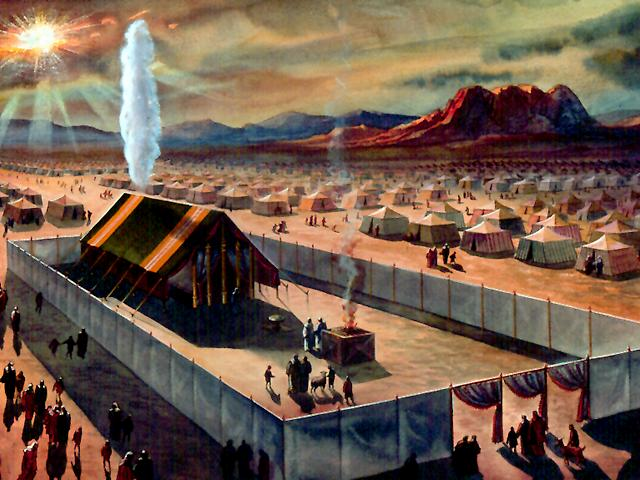
  • As a dwelling place for God, what were some limitations to the O.T. tabernacle?  What are some limitations in our lives as dwelling places for God?  (Check out below the cool artist’s rendition of what the tabernacle looked like.)
  • In your own words, what does 9:8 mean?
  • What is the “time of reformation” in 9:10?
  • Describe the differences and the efficiency in the sacrifice of Jesus.  (9:11-14)
  • What does 9:15 indicate about how O.T. people were saved?
  • Why is a “covenant valid only when men are dead”?  (9:17)
  • What does 9:22 teach about the priority of “blood”?
  • How many times did Jesus offer Himself as a sacrifice?  (9:25-28)  Why is this significant?

Arrive by 7 pm for dessert (Roc is bringing it!) … the study will start a few minutes later.

~ tr

Posted by: StrongStakes | April 25, 2011

Notes on Hebrews 8:1-13

Gentlemen,

Click here for my Hebrews 8:1-13 Notes.

Questions for next Monday’s study of chapter nine will be posted toward the end of this week.

Continue to pray for each other!

~ tr

Posted by: StrongStakes | April 20, 2011

A Better Covenant … plus bonus material on the Resurrection!

Gentlemen,

These eight questions will help prepare you for next Monday’s Bible study:

  1. How does Hebrews 8 demonstrate the superiority of the “new covenant” over the “old covenant”?
  2. What is the significance about the statement in v. 1, “… who has taken His seat …”?  Cf., 10:11 and Revelation 3:21.
  3. Why do we need a “mediator”?  (v. 6)
  4. In what ways will this “new covenant” affect the heart?  (v. 10) … be specific.  Cf., Ezekiel 11:19-20; 36:26-27; John 14:16-17; 2 Corinthians 3:2-6.
  5. How have you personally experienced the promise in v. 10?
  6. When did the old sacrificial system cease, or become “obsolete”?  (v. 13)  Cf., Matthew 27:50-51; Mark 15:37-39; Luke 23:44-46.
  7. Would you view sin differently if you were required to still bring animal sacrifices to a priest on an ongoing basis?
  8. How will this “new covenant” help you share with someone who is trying to earn God’s favor?  Cf., John 1:17; Galatians 3:13-29; 1 Timothy 2:5.

As you prepare to remember the death, burial and resurrection of Jesus Christ this weekend, take a look at this handout on Christ’s Death and Resurrection In the Old Testament.”

Monday’s Bible study begins at 7 pm with physical treats to eat, followed by a spiritual feast … see you then!

~ tr

Posted by: StrongStakes | April 18, 2011

Notes on Hebrews 7:11-28

Gentlemen,

Click here for my Hebrews 7:11-28 Notes.

Questions for next Monday’s study of chapter eight will be posted toward the end of this week.

Savor the memories of our Savior during this Passion Week.

Remember to pray for each other!

~ tr

Posted by: StrongStakes | April 10, 2011

Jesus’ Priesthood is Superior

Gentlemen,

These questions will help us navigate through the remainder of Hebrews 7.  Add them to the questions from two posts ago.

  • What is significant about Abraham paying a tithe to Melchizedek?  (vv. 4, 9, 10)
  • What is significant about Melchizedek’s genealogy not being traceable?  (v. 6)
  • What is significant about Melchizedek blessing Abraham?  (v. 7)
  • How do you answer the question posed in v. 11?
  • Describe the “change of law” mentioned in v. 12 … see also vv. 18, 19.
  • If Jesus is not qualified for the Levitical priesthood based on genealogy (vv. 13-14), then what qualifies Him to be our High Priest? … see also vv. 15-17, 20-21, 28.
  • What makes the covenant of Jesus “better” (v. 22) … see also vv. 19b, 25 … and His priesthood superior?  (vv. 26-27)
  • What does it mean for you personally that Jesus Christ is our High Priest forever?  (vv. 17, 21, 24-25, 28)
  • How will these truths revealed in Hebrews 7 give you more confidence to draw near to God in any and every circumstance?

See you Monday at 7 pm!

~ tr

Posted by: StrongStakes | April 4, 2011

Notes on Hebrews 7:1-10

Gentlemen,

Click here for my Hebrews 7:1-10 Notes.

Questions for the remainder of chapter seven will be posted by the weekend.

Remember to pray for each other!

~ tr

Posted by: StrongStakes | April 3, 2011

Priesthood of Melchizedek

Gentlemen,

Sorry for the late (< 24 hours) post of these questions for tomorrow night’s study.  Here is the handout for the entire chapter of Hebrews 7, although we will focus only on verses 1-10 on Monday.  Enjoy the graphic, too!

  1. Chapter 7 is considered the focal point of Hebrews … why?
  2. How does this chapter fit into the overall outline of the book?
  3. Read Genesis 14:17-24 for the historical context.
  4. Why the juxtaposition of “righteousness” and “peace” in Hebrews 7:2?
  5. Who is Melchizedek? … human? … angel? … pre-incarnate Jesus?
  6. Levites were priests based on bloodline, not character.  How might this have been problematic?


Rick H. is providing the dessert … see you by 7 pm!

~ tr

Posted by: StrongStakes | March 28, 2011

Notes on Hebrews 6:13-20

Gentlemen,

Please insert these verses into last week’s study notes on Hebrews 6:1-12, right after verse 8.

“Good Fruit … Bad Fruit … No Fruit”

  • Matthew 3:7-10 (John the Baptist)
  • Matthew 7:15-23 (Jesus)
  • Luke 13:6-9 (Jesus)
  • John 15:1-6 (Jesus)
  • 1 Corinthians 3:10-15 (Paul)

Click here for my Hebrews 6:13-20 Notes.

Questions for chapter seven will be posted later this week.

Remember to pray for each other!

~ tr

« Newer Posts - Older Posts »

Categories