Posted by: StrongStakes | October 2, 2013

What Wondrous Love

Gentlemen,

We concluded our in-depth study of Revelation 5 by listening to the Christian folk hymn, What Wondrous Love, which neatly summarizes the emphasis of this chapter.  First published in 1811, during the Second Great Awakening, this camp meeting song was sometimes described as a “white spiritual” from the American South.  For many years the hymn’s text was attributed to an anonymous author, until an 1848 hymnal identified a Methodist pastor from Oxford, Georgia named Alexander Means as the source.  The melody was derived from a popular English ballad, “The Ballad of Captain Kidd,” which described the exploits of pirate William Kidd.

The version we listened to Monday night was performed by the recent Christian band – “Jars of Clay.”  Click on the title above for another rendition by Fernando Ortega, along with a slideshow of beautiful nature scenes.  A handout with the lyrics for What Wondrous Love is available here.

What wondrous love is this, O my soul, O my soul!
What wondrous love is this, O my soul!
What wondrous love is this that caused the Lord of bliss
To bear the dreadful curse for my soul, for my soul,
To bear the dreadful curse for my soul.

When I was sinking down, sinking down, sinking down,
When I was sinking down, sinking down,
When I was sinking down beneath God’s righteous frown,
Christ laid aside His crown for my soul, for my soul,
Christ laid aside His crown for my soul.

To God and to the Lamb, I will sing, I will sing;
To God and to the Lamb, I will sing.
To God and to the Lamb who is the great I Am;
While millions join the theme, I will sing, I will sing;
While millions join the theme, I will sing.

And when from death I’m free, I’ll sing on, I’ll sing on;
And when from death I’m free, I’ll sing on.
And when from death I’m free, I’ll sing and joyful be;
And through eternity, I’ll sing on, I’ll sing on;
And through eternity, I’ll sing on.

Shalom!

~ tr
Posted by: StrongStakes | October 1, 2013

Repeat: Worthy is the Lamb!

Gentlemen,

Click on this link for the Revelation 5:1-14 Notes.  We viewed many unusual sights while accompanying the apostle John into God’s Throne Room!  But the most significant thing we learned was the necessity of Jesus being slain as a Lamb in order to secure our salvation, and so that He might return as the conquering King … the Lion of Judah … Worthy is the Lamb!

Embrace God’s grace! … Bask in that reality! … Abide in His Word!

Shalom!

~ tr

Posted by: StrongStakes | September 28, 2013

Necessary “Slain Lamb”

Gentlemen,

As you invest time pondering the questions “How/Why must a slain Lamb herald the Lion of Judah?” or “Why was it necessary for Jesus to first come as a ‘Suffering Servant’ before He comes as the conquering King?” (see previous post), here are some Scripture passages that will assist you:

  • Isaiah 53:4-6, 10-11
  • Isaiah 59:1-2
  • Romans 3:21-26
  • Ephesians 1:7-10
  • Colossians 1:19-20
  • Hebrews 2:14-17
  • 1 John 2:1-2

This is certainly not an exhaustive list, so be on the lookout for cross-references, too.

See you at Monday’s Bible study … Shalom!

~ tr

Posted by: StrongStakes | September 24, 2013

Slain Lamb heralds Lion of Judah

Gentlemen,

At last night’s Bible study about Revelation 5, a poignant question was asked (thanks Ryan!) …

“Why was it necessary for Jesus to first come as a ‘Suffering Servant’ before He comes as the conquering King?”

Or, asked in the imagery portrayed in Revelation 5, the question looks like this …

“How/Why must a slain Lamb herald the Lion of Judah?”

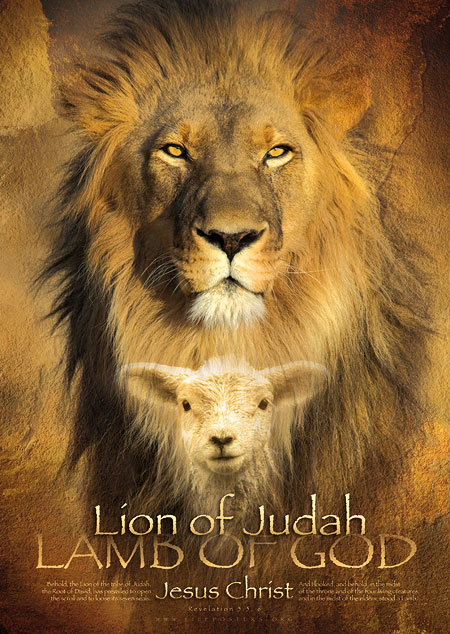
Lion of Judah_Lamb of God

This is a question for the ages! … the O.T. prophet Isaiah diligently presents a comprehensive answer(s) to this question … in fact, the answer to this question causes all those present in God’s Throne Room in Revelation 5 to spontaneously break out in a massive celestial choir!

In preparation for our second look at Revelation 5 next Monday, invest a quantity of time pondering this question.  Be a “good Berean” … study the Scriptures to discover the answer.

Here’s a tip:  The key, operative word in the question is “necessary”!

See you next Monday!

Shalom!

~ tr

Posted by: StrongStakes | September 22, 2013

Worthy is the Lamb!

Gentlemen,

In Revelation 4, God the Father was at center stage with the Holy Spirit also present.  Now in chapter 5, the Second Person of the Trinity is introduced.

  • What is the occasion of this introduction of Jesus … what are the circumstances?
  • What clues in chapter 5 point to the fact that this is Jesus?
  • What do you notice about the scroll (book) in v. 1?  What is the significance?
  • From where in the O.T. are Jesus’ two titles (v. 5) borrowed?
  • Why does Jesus’ title change in v. 6?
  • What action occurs in v. 7?  Why is this significant?
  • Why do the four creatures and 24 elders have harps and golden bowls in their hands?
  • Unpack the 4-fold description of who gets purchased by the blood of Jesus.
  • Who will join in this celestial choir?

Read through Revelation 5 a few times before Monday night’s study to get familiar with the content we will be discussing Monday night.  Click on this link for a note-taking handout on Revelation 5:1-14.

Rick H. is bringing the dessert, which will be served at 7 pm, so arrive in time to enjoy that.  Our study/discussion will start shortly after that.

Shalom!

~ tr

Posted by: StrongStakes | September 20, 2013

Take-aways from “God’s Throne Room”

Gentlemen,

“Worthy are You, our Lord and our God, to receive glory and honor and power; for You created all things, and because of Your will they existed, and were created.”  Revelation 4:11

Of the many take-aways from our recent study of Revelation 4:1-11 … God’s Throne Room … perhaps the most significant is that everything in existence is most accurately described and understood in its relationship to the throne of God.

For several other insights, click on Revelation 4:1-11 Notes.

You may also want to download a handout for Revelation 5:1-14 for note-taking at next Monday’s study.

Shalom!

~ tr

Posted by: StrongStakes | September 18, 2013

The Fall Feasts: Succoth

“Speak unto the children of Israel, saying, ‘The fifteenth day of this seventh month shall be the feast of tabernacles for seven days unto the LORD … Ye shall dwell in booths seven days; all that are Israelites born shall dwell in booths: That your generations may know that I made the children of Israel to dwell in booths, when I brought them out of the land of Egypt: I am the LORD your God.’” — Leviticus 23:34, 42–43

The Feast of Tabernacles, or Succoth, begins on the 15th of Tishri and lasts for eight days.  This year Succoth will begin on the evening of September 18th and will run through September 25th.  The word Succoth (also spelled Sukkot or Succot) means “booths,” and refers to the temporary dwellings which are built and inhabited during the festival.  This feast commemorates the 40 years that the nation of Israel wandered in the desert before entering the Promised Land.  The Feast of Tabernacles or the Feast of Booths, as it is sometimes called, is a joyous holiday and a time of feasting.  These temporary “booths” are built in the traditional way, leaving deliberate gaps in the branches to view the stars at night, and for the wind to blow through during the day.  This is intended to remind them of the wilderness wanderings.

At the end of the eight days, they leave their temporary dwellings to return to their permanent homes. (This is one of the reasons some suspect that this feast, rather than the Feast of Trumpets, is suggestive of the Rapture of the Church.) This day, traditionally, is the day that Solomon dedicated the first Temple.

This feast also involved a daily processional to the Pool of Siloam to fetch water for the Temple.  This ceremonial procession is the setting for the events of John 7, where Jesus offers them “living water.”  This procession involved four types of branches: the willow, the myrtle, the palm, and a citrus (Leviticus 23:40).  The willow has no smell and no fruit.  The myrtle has smell, but no fruit.  The palm has no smell, but bears fruit.  The citrus has both smell and bears fruit.  This sounds reminiscent of the four soils of the first “kingdom parable” of Matthew 13. The prophetic implications of this climactic feast are diverse, and many scholars associate it with the establishment of the Millennial Kingdom in Israel.

The Torah—the five books of Moses—describes seven feasts on the Hebrew calendar.  Three feasts are in the spring, in the month of Nisan: Passover, the Feast of Unleavened Bread, and the Feast of First Fruits.  Many Bible scholars believe that the first three feasts are prophetic of the Lord’s First Coming.  Then fifty days later there is the Feast of Weeks, Shavout, also known as Pentecost.  The feast of Pentecost may be predictive of the Church.  Pentecost is notably the only feast in which leavened bread is ordained.  There are three remaining feasts in the fall, in the month of Tishri: the Feast of Trumpets, the Day of Atonement, and the Feast of Tabernacles.  The fall feasts may be prophetic of the Lord’s Second Coming.

The feasts of Israel present numerous prophetic parallels.  At times the tasks and rituals described in the Old Testament, particularly in the book of Leviticus, may seem laborious or even inapplicable to Christians today.  However, it is important to remember that every number, every place name, every detail, every jot and tittle found in Scripture is there for our learning, our discovery, and our amazement.  Truly, our God is an awesome God!

~ Adapted from the September 10, 2013 eNews issue from KHouse.org

*Click on The Fall Feasts: Succoth to download this as a handout.

Shalom!

~ tr

Posted by: StrongStakes | September 17, 2013

Meet Jesus @ Beach (this Sat.)

Gentlemen,

I encourage and exhort you to join us this Saturday, September 21st, from 7 – 9 am for another rich time of fellowship with our Lord and with each other.  Click on the link for a two-page handout including details and a map for this Saturday morning’s Meet Jesus @ Beach gathering at the Montage Resort in south Laguna Beach.

Feel free to invite a friend (or two) and share the handout with them, too, or simply direct them to this blog post.

Plan to arrive a few minutes prior to 7 am so we can get started on time.

Shalom!

~ tr

Posted by: StrongStakes | September 13, 2013

Yom Kippur

“Also on the tenth day of this seventh month there shall be a day of atonement: it shall be an holy convocation unto you; and ye shall afflict your souls, and offer an offering made by fire unto the LORD.  And ye shall do no work in that same day: for it is a day of atonement, to make an atonement for you before the LORD your God.”  ~  Leviticus 23:27–28

Yom Kippur, the Day of Atonement, is perhaps the most important holiday of the Jewish year.  Yom Kippur is observed on the 10th of Tishri, which this year starts at sunset on Friday, September 13 as the new day begins on the Jewish calendar.  All day on the 10th of Tishri, Jews will take off work and fast for this holy and most solemn day of repentance and reconciliation.

It was on this day — the only day — that the High Priest was able to enter the Holy of Holies, and then only after elaborate ceremonial washings, offerings, and associated rituals.  This was also the day that two goats were selected, one for an offering and one as the “scapegoat.”  As many aspects of the feasts were prophetic, the scapegoat is also Messianic.  The ceremonial acts that were to be carried out by the High Priest on Yom Kippur are described in Leviticus 16 (see also Exodus 30:10; Leviticus 23:27–31, 25:9; Numbers 29:7–11).  Since the loss of the Temple in 70 A.D., the God-centered observances of the Torah have tragically been replaced with a man-centered, good works system of appeasement through prayer, charity, and penitence.

Yom Kippur traditionally ends with one long note of the Shofar, a musical instrument usually made from a ram’s horn.  The significance of the ram’s horn is traditionally rooted in Genesis 22.  Here God commands Abraham, ”Take now thy son, thine only son Isaac, whom thou lovest, and get thee into the land of Moriah; and offer him there for a burnt offering upon one of the mountains which I will tell thee of.”  Abraham is called upon by God to sacrifice his only son, Isaac, as a test of his faith.  After God halts the sacrifice at the last minute, Abraham spies a ram trapped by his horns in a nearby thicket and offers the animal instead as a sacrifice.

It is interesting to note that this is the first instance in which the word “love” appears in Scripture.  God commands Abraham to sacrifice “thine only son Issac, whom thou lovest.”  In this passage Issac is identified as Abraham’s only son, but what about Ishmael?  If you examine this passage of scripture in detail it becomes clear that Abraham was acting out prophecy.  This strange event was a foreshadowing of Christ’s death on the cross as a substitutionary offering for our sins.  In fact, it may have even taken place at the very same spot where the “only begotten Son” of God was later crucified.

Woven throughout the Old Testament feasts is the foreshadowing of God’s plan for the redemption of mankind.  Those of us who have placed our trust in Jesus Christ are able to enter behind the veil and stand in the Holy of Holies.  We have forgiveness because of the sacrificial death of Jesus Christ on the cross.  He is our scapegoat.  His blood was sprinkled for our atonement, and because of him we are cleansed and made holy before God.

~ from the September 03, 2013 eNews issue from KHouse.org

*Click on The Fall Feasts: Yom Kippur to download this as a handout.

Shalom!

~ tr

Posted by: StrongStakes | September 10, 2013

An Unhurried Life

Gentlemen,

Many of you in the OC Bereans Bible study know that I wrestle with the “Martha Syndrome” … that malady that seeks to serve Jesus, His people, and His Kingdom while often forsaking the intimate relationship that Jesus desires from me.  Luke 10:40 contrasts how “Martha was distracted with all her preparations” … brought on by the visit of Jesus … with her sister Mary’s choice, “who was seated at the Lord’s feet, listening to His word.” (v. 39)

A helpful resource in this regard is a thought-provoking book, An Unhurried Life, written by Alan Fadling, who lives in Mission Viejo.  I heartily recommend the book, from which I have already shared several quotes with you.  The book’s subtitle, “Following Jesus’ Rhythms of Work and Rest,” along with a sampling of the following chapter titles will give you a quick overview of his emphases:

  • An Unhurried Apprentice
  • Productivity: Unhurried Isn’t Lazy
  • Temptation: Unhurried Enough to Resist
  • Unhurried Enough to Care
  • … and more …

Click on the book title above for a link to purchase his book.  You may also download for free his chapter one at The Leadership Institute website.

By the way, if you have a Twitter account, consider following @StrongStakes, where I frequently post brief quotes and thoughts about following Jesus.

Happy reading! … Shalom!

~ tr

« Newer Posts - Older Posts »

Categories